MEDIATION

IN GENERAL

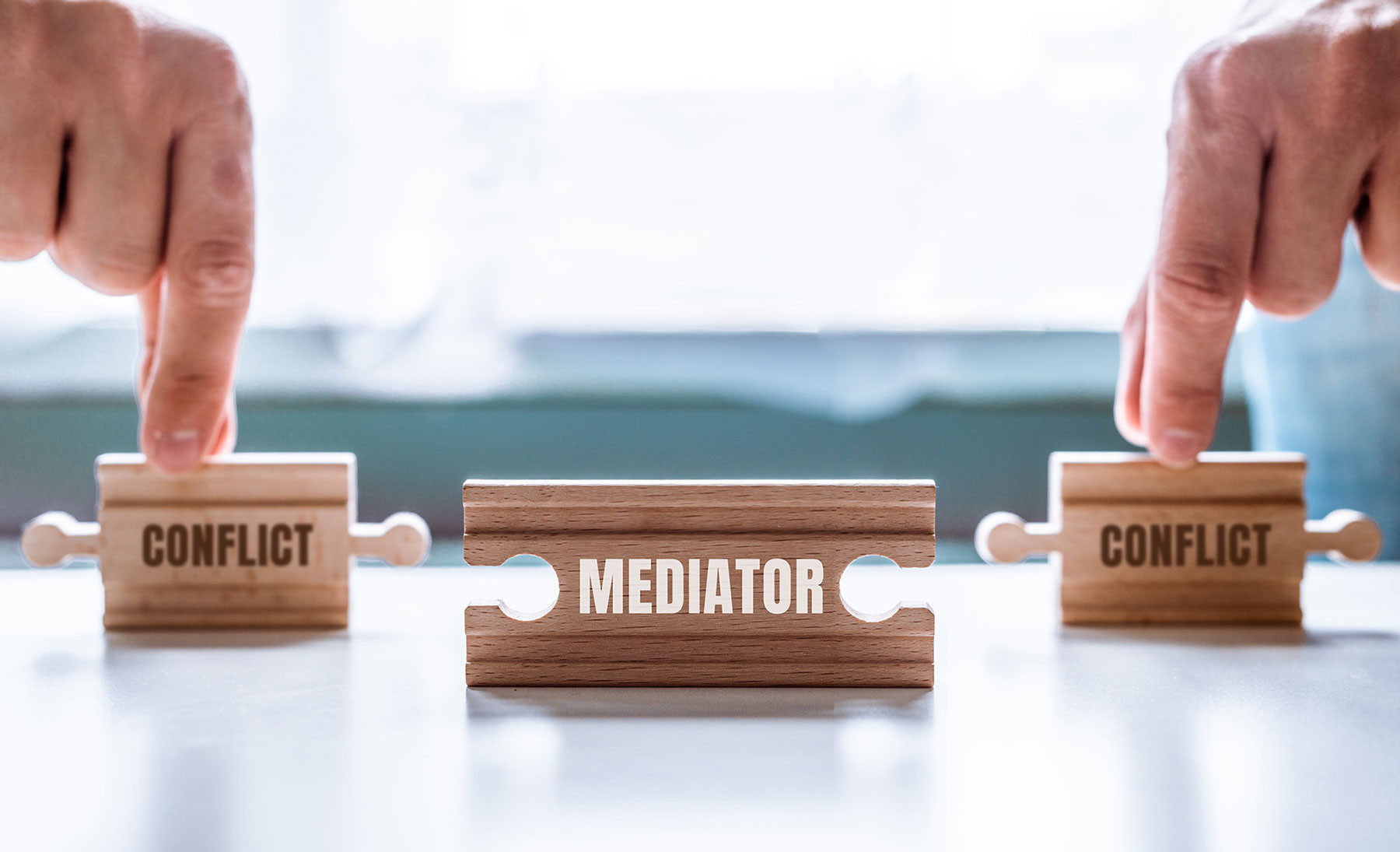
Mediation is an extrajudicial, voluntary method, which enables conflicting parties to take responsibility in finding a solution. This is both valid for the constructive management of projects as well as dealing with conflicts.

The mediator ensures a confidential, secure framework and accompanies the parties through the mediation process in an unbiased and professional way. Mediators give the needed structure to the discussions. The responsibility for finding a workable and sustainable solution lies entirely with the conflicting parties throughout the process.

Mediation can be used in a variety of situations such as businesses, administration, organizations, families and in private environments.

The aid of a neutral, solution oriented mediator is recommended if the participants are interested in continuing an existing non-, or voluntary relation.

ADVANTAGES

MEDIATION

TIME SAVING
The mediation process doesn’t need long preparation. The conflict mediation is manageable in a relatively short time. the interval between meetings is determined by the parties themselves. Hence the mediation process can be very efficient.
COST SAVING
Especially when financial claims are high, mediation is significantly cheaper than a judicial process. The unbureaucratic approach saves costs.
MAINTAINING RELATIONSHIPS

The mutual settlement of a dispute offers a good perspective for the continued co-operation between parties. Therefore financial disadvantages, which could result in damaged business or personal relations, can be avoided.

CONFIDENTIALITY

All details discussed in the mediation process or regarding the involved parties are strictly confidential and are not published. This guarantees protection from loss of face and negative publicity.

PROTECTION OF OWN INTERESTS

The involved parties are the best suited in finding solutions to manage their conflict. They take responsibility in developing tailor-made arrangements guided by the mediator. This ensures win-win solutions.

SECURITY FOR PLANNING

In kurzer Zeit wird eine verbindliche Lösung vereinbart, die die Unsicherheit für weitere Planungen verhindert.

DECISION MAKING POWER

The involved parties determine the content of the mediation process and keep control over its result. The result will consequently be accepted by both sides.

GUIDING
PRINCIPLES

MEDIATION

Voluntary participation
The voluntary participation in the mediation process contributes largely to satisfying results.

Confidentiality
The mediator must handle all information as confidential.

Unbiased attitude
The mediator must be unbiased and impartial towards all involved parties.

Result orientation
At the start of a mediation process the result is unclear. The process aims at finding a sustainable solution, which is developed with active participation of the involved parties.

Responsibility
Die Content responsibility of the mediation process lies solely with the parties. The mediator is responsible for the structure, and guiding of the process.

Angela Zickler

Neckarsulm

· Wirtschaftsmediation

· Familienmediation

· Erbmediation

· Mediation in Kirche und Verein


Steinachstrasse 21 | 74172 Neckarsulm

Telefon 07132 – 948 76 10

info@ra-zickler.de

ra-zickler.de

Angela Dorschel

Schwaigern

· Wirtschaftsmediation

· Familienmediation

· Mediation in Kirche und Verein

· Mediation in der Schule

· Planen und Bauen


Schwaigern

Mobil 0171 – 849 88 66

mail@angela-dorschel.de

www.angela-dorschel.de


Paola Balasso

Heilbronn

· Interkulturelle Mediation

· Wirtschaftsmediation (Familienunternehmen, betriebliche Mediation)

· Mediation im Kulturbereich

· Mediation in Kirche und Verein

· Mediation in der Schule


Eckenerstraße 101 I 74081 Heilbronn

Mobil 0151 – 507 35 701

balasso@balasso-coaching.com

www.balasso-coaching.com